
Texture Matching
A perfect patch with the wrong texture is still a visible patch. We match orange peel, knockdown, and skip trowel until the repair reads as wall, not work.
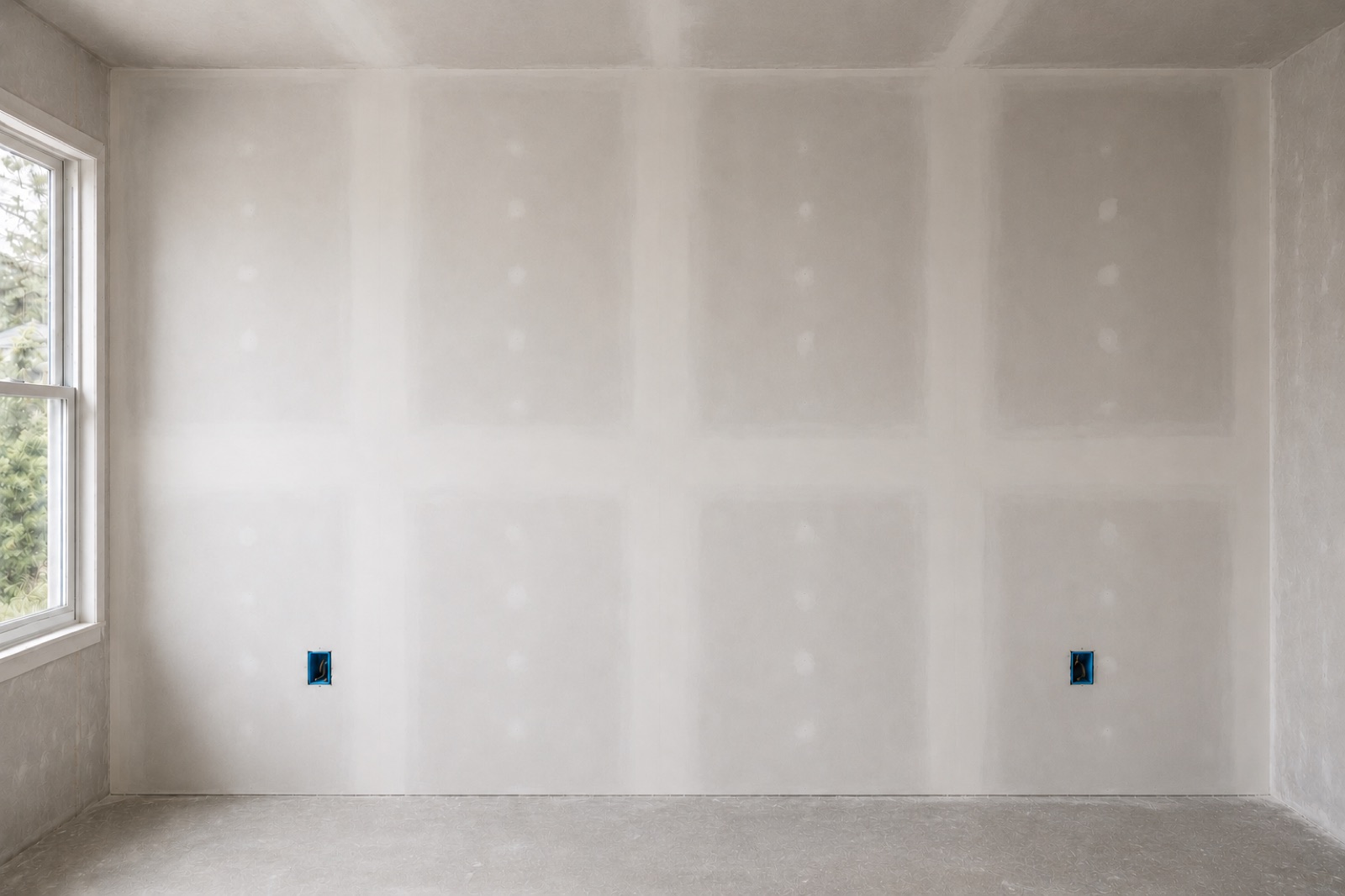
Texture is the fingerprint of your walls, and no two jobs wear it exactly alike. The spray pressure, the mud thickness, the knockdown timing, even how the original crew held the gun all live in that surface. So when a repair gets textured wrong, your eye finds it instantly, the way you'd spot one mismatched tile in a floor. Castle Construction treats texture matching as its own discipline: identify the pattern, replicate it on test boards, and blend it in so the fix vanishes.
Reading the Texture You Already Have
Before anything gets sprayed, we figure out what we're matching. Orange peel is the most common: a fine splatter, sprayed and left alone, with a surface like its namesake. Knockdown starts the same way, then gets flattened with a knife after the splatter tacks up, leaving mottled plateaus. Skip trowel is a hand texture, mud pulled across the wall so the trowel skips and leaves irregular islands. Each one has a family of variations in size, density, and depth.
We also read the history. Many walls carry texture over texture, a skim of paint-thickened roller stipple, or a previous repair that never quite matched, and blending into an imperfect original takes judgment about what the eye actually keys on. Pattern scale and sheen matter more than perfection. Get those two right and the surface reads as continuous. Get either wrong and the wall might as well have an arrow painted on it.
Test Boards Before Your Wall Sees Anything
Texture is timing and pressure, and you don't rehearse on the customer's wall. We dial in the match on scrap board first: adjusting air pressure, tip size, and mud consistency for sprayed patterns, and practicing the trowel motion and mud thickness for hand textures. Knockdown gets the extra variable of wait time, since flattening the splatter a few minutes early or late completely changes the plateau size. The test board holds against your wall until it disappears at conversation distance.
Only then do we shoot the repair, feathering the new texture past the patch edges so there's no visible boundary where new meets old. After it dries, everything gets primed and painted to a natural break, a corner or an edge, because a sheen line will betray a texture match that's otherwise perfect. This is the finishing half of our patch and repair work, and it's the half that decides whether anyone can ever find the patch.
Textures We Match
Most of our matching work follows a repair: a patched hole in an orange peel hallway, a replaced section of knockdown after a plumbing leak, a skip trowel accent wall that took damage in a move. We also blend texture across additions and remodels, where a new smooth wall meets an old textured one and the transition needs to happen at a corner or not at all. And when a whole wall is too scarred to blend, we can retexture it end to end.
The other direction matters too. Plenty of clients want texture gone, not matched, and we handle smooth-overs: skimming a textured wall flat with multiple thin coats, sanding, and finishing to a Level 5 standard so the new smooth surface holds up under light. Whichever way you're going, texture to texture or texture to smooth, the measure is the same. Stand in the room afterward and try to find the work.
- Orange peel, from fine mist to heavy splatter
- Knockdown, matched for plateau size and timing
- Skip trowel and other hand-applied patterns
- Roller and stipple textures on older walls
- Full-wall retexture when blending isn't realistic
- Smooth-overs: texture skimmed flat and finished
Popcorn Removal and the Transition Problem
Popcorn ceilings are their own case. Removal means scraping the acoustic texture, repairing the inevitable gouges, then skimming and refinishing the lid, and homes from the popcorn era should have the material tested before anyone disturbs it. Once it's down, you choose the new surface: smooth, which demands near-Level 5 flatness because ceilings live in raking light, or a new sprayed texture that's more forgiving. Our ceiling work service handles the overhead side of this in full.
The transition is where these jobs get won or lost. If you're removing popcorn in one room, the new ceiling has to meet its neighbors somewhere, and that line needs to land at a natural break so the change reads as intentional. Same with walls: texture changes at corners look designed, texture changes mid-wall look like a repair. Castle Construction plans those boundaries before the work starts, which is the difference between a house that got fixed and a house that looks fixed.
Common Questions
Can you really make a patch invisible in a textured wall?
On common textures like orange peel and knockdown, yes, that's the standard we work to. We match pattern scale on test boards first and feather the new texture past the repair. The honest caveat: paint sheen must also match, which is why we paint to a natural break like a corner.
How do you figure out what texture my wall has?
By eye and by hand, up close. Orange peel is sprayed splatter left alone, knockdown is splatter flattened with a knife, and skip trowel is pulled on by hand. We also gauge the scale and density of yours specifically, then replicate it on scrap board until it holds up next to the real wall.
Do you remove popcorn ceilings?
Yes, through our ceiling work service. The job is scrape, repair, skim, and refinish, either smooth or with a new texture. One caution we take seriously: popcorn in homes of a certain age can contain asbestos, so the material should be tested before anyone scrapes anything. We'll walk you through that first.
Why does my old repair stick out even though it's smooth and painted?
Smooth is the problem. A flat patch in a textured wall reflects light differently than everything around it, so your eye flags it instantly. Often the sheen is off too, from paint applied without primer. The fix is retexturing the patch to match and repainting to a natural break.
Let's get your drywall handled.
Straight answers, fair numbers, walls built like they matter.
Get a Free Quote